

Science rarely announces itself loudly. The most important discoveries of our time tend to arrive quietly — as a paper in a specialist journal, a result from a field trial, a number that nobody expected. And then, slowly, the world realises everything has shifted.
2026 is already one of those years.

From Australian waters to laboratories across the globe, breakthroughs are happening right now that will reshape how we live, what we eat, how we power our homes — and whether the Great Barrier Reef survives the century.
Here are five you need to know about.
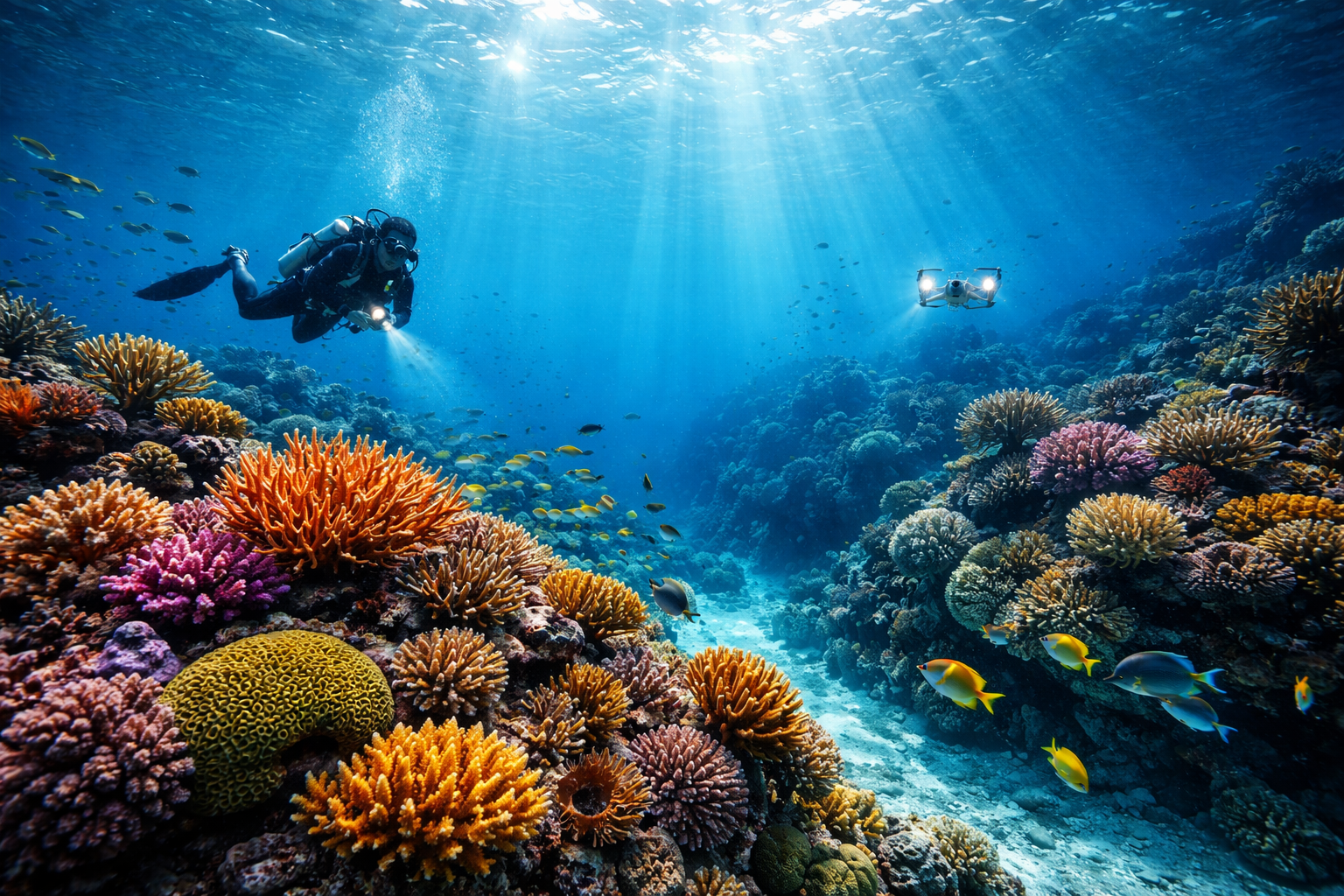
1. Gene-Edited Coral Is Being Deployed on the Great Barrier Ree
This is the one that stopped the scientific community in its tracks.

Researchers at the Australian Institute of Marine Science and Stanford University successfully deployed gene-edited coral fragments to sections of the Great Barrier Reef in late 2025. The corals were edited to enhance expression of heat-shock proteins — molecular chaperones that protect cellular structures during thermal stress.
Why does this matter? Because coral bleaching — driven by rising ocean temperatures — is the single biggest threat to the reef’s survival. The 2024 bleaching event was the most extensive ever recorded.
If gene-edited corals demonstrate sustained survival at temperatures 1.5–2°C above current bleaching thresholds, the technique could become a tool for reef restoration at scale.
The reef covers 344,400 square kilometres off the Queensland coast. It supports 64,000 jobs and contributes an estimated $6.4 billion annually to the Australian economy. It is also home to more than 1,500 species of fish and 4,000 types of mollusc. Losing it is not an option.
For the latest updates on reef science visit the Australian Institute of Marine Science at aims.gov.au.
2. An Enzyme Has Been Engineered to Eat Plastic in 48 Hours
Plastic pollution is one of the defining environmental crises of our era. Now science may have found a biological answer.
Building on the 2016 discovery of Ideonella sakaiensis — a bacterium that naturally breaks down PET plastic — enzyme engineering teams have created variants that degrade polyethylene under ambient conditions. A 2025 paper in Science reported complete degradation of thin-film polyethylene in 48–72 hours using an engineered enzyme cocktail.
Polyethylene accounts for roughly 30% of all plastic production. No natural degradation pathway existed for it until now. Enzymatic recycling could complement mechanical recycling by handling contaminated, mixed, or degraded plastic streams that current systems reject.
The challenge now is scale — making this work in industrial volumes at a cost that makes commercial sense. But the proof of concept exists. The science is real.
3. Solar Cells Just Broke a 34% Efficiency Record
The economics of solar power have been transforming for a decade. In 2026 they just changed again.
Tandem perovskite solar cells — made of perovskite and silicon — have reached power conversion efficiencies over 34%, a significant improvement over existing commercial silicon-based panels that can reach about 24%.
A 10 percentage point jump in efficiency sounds technical. What it means in practice: the same roof space produces significantly more electricity. Fewer panels for the same output. Lower cost per kilowatt-hour.
New material science battery technologies are also surpassing current lithium-ion batteries in cost and material availability — and in 2026, several options are ready for commercialisation at the scale that utilities need.
For Australians — already among the highest adopters of rooftop solar in the world — this is directly relevant. More information on Australia’s clean energy transition is available at cleanenergycouncil.org.au.
4. Australian Researchers Are Using AI to Discover New Viruses
The COVID-19 pandemic exposed how little we know about the viral world living in our oceans, rivers and soils. Australian scientists are now using artificial intelligence to change that — fast.
Professor Edward Holmes at the University of Sydney has been awarded $686,135 through the Australian Research Council’s Discovery Projects 2026 round to use artificial intelligence and genetic sequencing to discover new types of RNA viruses in Australian marine and freshwater sediments and understand how they evolve.
The implications are significant. Understanding which viruses exist in our environment — before they reach humans or animals — is one of the most powerful tools we have for pandemic preparedness. Australia’s unique ecosystems make it one of the most important places on earth to conduct this research.
The University of Sydney alone was awarded $38.6 million across the 2026 ARC Discovery Projects round — almost 10% of all national funding awarded in the scheme.
More on Australian research investment at arc.gov.au.
5. Australia’s Rare Earth Deal With the US Has a Hidden Cost
On 20 October 2025, Australia signed an agreement with the United States to strengthen supply chains for rare earth mineral mining and processing. Rare earth minerals are indispensable to the manufacture of high-performance magnets, batteries, and other materials vital to clean energy, communications, aerospace, and defence technology. Global demand for rare earth minerals is expected to double by 2050.
But a paper published in the journal Science has raised an urgent warning.
Australia’s rare earth plans may imperil biodiversity. While the US-Australia rare earths framework may bolster Australia’s domestic processing capacity, the economic benefits could come at a cost to global biodiversity.
It is one of the central tensions of the clean energy transition: the minerals needed to build a green future must be dug out of the earth, often from ecosystems of extraordinary ecological value.
The conversation about where, how, and at what cost to extract those minerals is one of the most important in Australian policy right now. Follow the latest from the Department of Climate Change, Energy, the Environment and Water at dcceew.gov.au.
Why This Matters for Australia
Australian taxonomists discover more new species every year than almost any other country in the world. The 30th National Science Week will be held from 15 to 23 August 2026 — Australia’s biggest grassroots science festival, reaching 3 million Australians via more than 2,000 registered events.
Science is not something that happens elsewhere, in other countries, to other people. It is happening here. In Queensland’s coral waters. In Sydney’s university laboratories. In the red earth of the outback where rare earth deposits sit waiting.
The discoveries of 2026 are Australian stories. And they are just getting started.
Australian science news: scimex.org Great Barrier Reef research: aims.gov.au Clean energy transition: cleanenergycouncil.org.au Australian Research Council funding: arc.gov.au Environment and climate policy: dcceew.gov.au
This article is for general informational purposes only. Scientific findings referenced are based on published research and publicly available data at time of writing.