
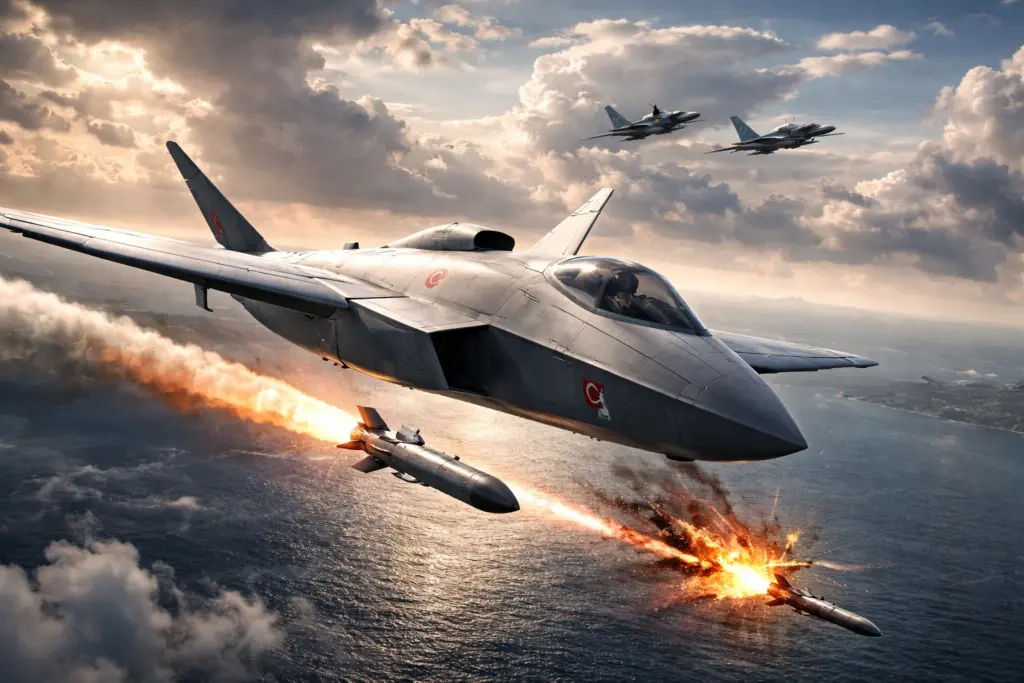

Turkey’s defence industry has taken a dramatic leap forward by enabling an unmanned combat aircraft to intercept and destroy a moving supersonic aerial target. This breakthrough blurs the line between traditional manned fighter jets and autonomous drones, signalling a new era in air combat and air‑defence strategy.
What actually happened in the “historic” test?
In the recent live‑fire test, a Turkish combat drone detected, tracked and engaged a high‑speed jet‑powered target drone using a radar‑guided air‑to‑air missile. The engagement took place at beyond‑visual‑range conditions, with onboard active electronically scanned array (AESA) radar guiding the missile to a direct hit on the supersonic target.
Key points from the test scenario:
- The drone used an indigenous AESA radar (Murad) to locate and lock onto the aerial target.
- It launched a Turkish‑made Gökdoğan beyond‑visual‑range air‑to‑air missile.
- Test footage shows the missile lofting and then striking the jet‑powered supersonic drone almost head‑on.
For readers wanting a technical deep‑dive into AESA radar and BVR engagements, this overview by The War Zone explains how radar‑guided air‑to‑air missiles are typically employed in modern air combat.
Why this matters for drone warfare
This test is significant because earlier drone combat roles were mostly focused on surveillance and air‑to‑ground strikes, not dynamic air‑to‑air engagements against fast, manoeuvring targets. By successfully prosecuting a moving supersonic target, Turkey’s unmanned platform demonstrates that drones can begin to assume roles traditionally reserved for manned fighters, such as air policing, interception, and defensive counter‑air missions.
Broader implications for airpower and defence planning:
- Force multiplication: Unmanned combat air vehicles (UCAVs) can complement or relieve manned fighters in high‑risk environments.
- Cost and risk reduction: Drones can take on dangerous missions—like intercepting cruise‑missile‑like threats—without risking pilots.
- Doctrinal change: Air forces will need new tactics, training, and command‑and‑control concepts to integrate autonomous shooters into their air picture.
For a broader look at how unmanned systems are reshaping airpower doctrines, NATO’s public materials on future air and space power provide useful context.
How Turkey got here: Bayraktar and Kizilelma
Turkey’s achievement builds on years of investment in indigenous drones such as Bayraktar TB2, TB3 and the jet‑powered Kızılelma UCAV. The Kızılelma project, in particular, aims to deliver a low‑observable, carrier‑capable unmanned fighter with supersonic performance and substantial weapons payload.
Recent related milestones include:
- Bayraktar Kızılelma conducting a “world first” radar‑guided air‑to‑air missile test against a jet‑powered aerial target.
- Bayraktar TB3 launching supersonic UAV‑122 missiles and hitting small sea targets from over 50 km away.
- Demonstrated cooperative engagements where one drone designates a target and another executes the strike.
Readers interested in the evolution of Baykar’s drone family and specs can find detailed profiles on defence‑focused resources such as Quwa and open‑source intelligence blogs.
What this could mean for future conflicts
Looking ahead, drones capable of autonomously engaging supersonic threats will likely influence arms races, air‑defence architectures, and export markets. Countries investing in advanced UCAVs may gain cheaper, more attritable options for air superiority and cruise‑missile defence, while also raising questions about rules of engagement, autonomy, and escalation in contested airspace.
For additional context on how emerging drone capabilities are changing global security and export controls, reports from think‑tanks like RAND and SIPRI on armed UAV proliferation are valuable further reading.