
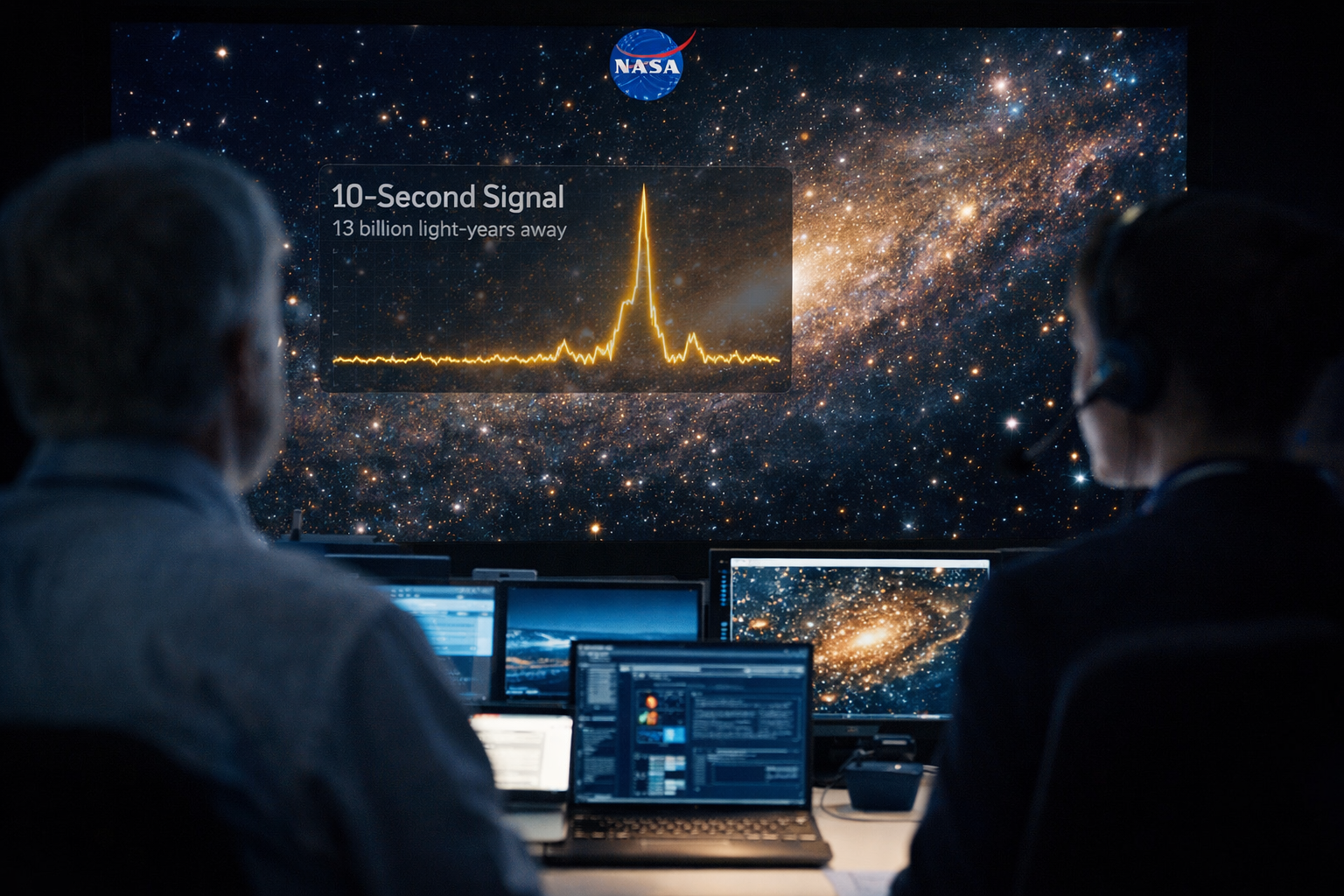

In March 2026, scientists working with NASA reported receiving a brief but highly significant signal originating from more than 13 billion years ago. Lasting only around ten seconds, the signal is being described as a rare observational window into the early universe, a period shortly after the formation of the first stars and galaxies.
The discovery has drawn global attention because signals from such vast distances are not only difficult to detect but also carry information from a time when the universe was still in its infancy.
What Scientists Detected
The signal, captured through advanced space-based observation systems, is believed to be linked to a high-energy cosmic event such as a gamma-ray burst or the collapse of an early massive star. These events release enormous amounts of energy and can travel across billions of light-years before reaching Earth.
Because of the immense distance involved, scientists are effectively observing a moment that occurred over 13 billion years ago, making it one of the oldest detectable signals ever recorded. Instruments designed to capture faint and distant cosmic activity played a crucial role in identifying and confirming the event.
Why This Matters
Discoveries like this are essential for understanding how the universe evolved. Signals from the early universe provide insight into the formation of the first structures, including stars, galaxies, and black holes. They also help refine existing models of cosmic expansion and energy distribution.
For researchers, each detection adds a new piece to a much larger puzzle. Observing ancient cosmic events allows scientists to test theories about how matter behaved under extreme conditions and how the universe transitioned from darkness to the structured cosmos seen today.
| Key Point | Detail | Significance |
|---|---|---|
| Signal Duration | ~10 seconds | Extremely brief but high-value data |
| Age | Over 13 billion years | Among the oldest signals observed |
| Source Type | Likely high-energy cosmic event | Insight into early universe activity |
| Organisation | NASA-led observation | High scientific credibility |
What Comes Next
Scientists will now analyse the signal in greater detail to determine its exact origin and characteristics. This includes studying its energy profile, frequency patterns, and potential source location. Additional observations from other telescopes may help confirm whether similar events are detectable.
The discovery is also expected to influence future missions, with increased focus on capturing early-universe signals more frequently and with greater precision. As observational technology improves, researchers hope to build a clearer timeline of cosmic evolution.
Conclusion

The detection of a 10-second signal from over 13 billion years ago represents a significant step forward in understanding the universe’s earliest moments. While brief, the signal carries valuable information that could reshape current scientific models and deepen knowledge of how the cosmos formed.
As research continues, discoveries like this highlight how much of the universe’s history remains to be explored.
Disclaimer
This article simplifies complex scientific findings for general understanding. Interpretations may evolve as new data and further analysis become available.