
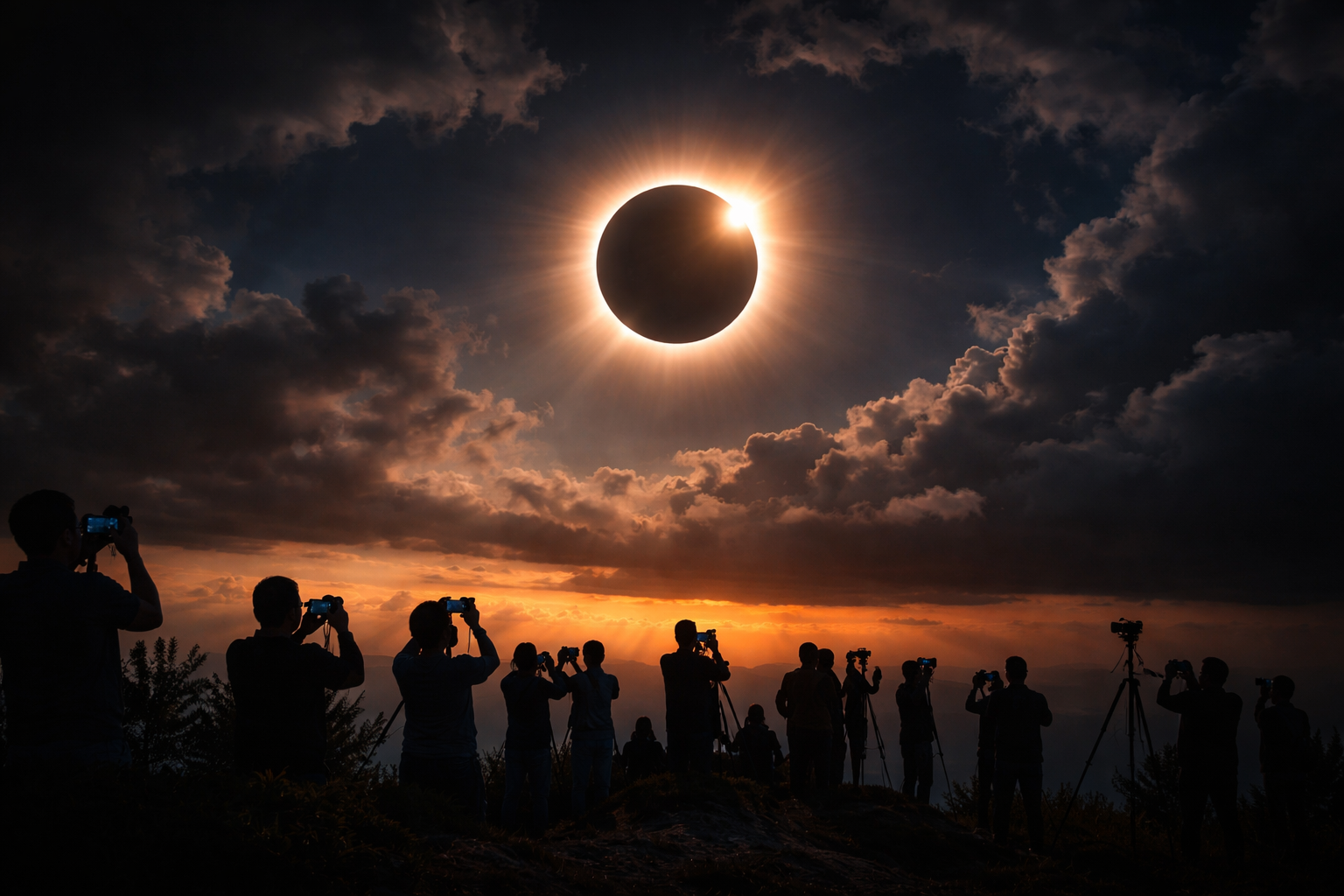

Astronomers have confirmed the date of what is expected to be the longest total solar eclipse of the 21st century, drawing global attention to a rare astronomical event that will briefly turn day into night. According to calculations verified by NASA, the eclipse is scheduled for August 2, 2027, and is expected to deliver an unusually long period of totality in certain regions.
Events of this scale are exceptionally rare, and scientists are already preparing for what could become one of the most widely observed celestial phenomena in decades.
What Scientists Confirmed

A total solar eclipse occurs when the Moon passes directly between the Earth and the Sun, temporarily blocking sunlight and casting a shadow over specific areas of the planet. While total solar eclipses are not uncommon, the duration of totality — the period when the Sun is completely obscured — varies significantly.
The 2027 eclipse stands out because of its extended duration, with some regions expected to experience over six minutes of total darkness. This is significantly longer than most eclipses, which typically last only a few minutes.
The path of totality is projected to pass across parts of southern Europe, North Africa, and the Middle East, making it accessible to millions of observers.
Why This Matters

Beyond its visual impact, the eclipse presents a valuable opportunity for scientific research. Extended totality allows astronomers to study the Sun’s outer atmosphere, known as the corona, under optimal conditions. Observations during eclipses can reveal details about solar activity, magnetic fields, and energy emissions that are otherwise difficult to detect.
For the general public, such events offer a rare chance to witness a large-scale astronomical phenomenon firsthand. Historically, total solar eclipses have attracted significant global interest, driving travel, tourism, and public engagement with science.
| Key Point | Detail | Significance |
|---|---|---|
| Event Type | Total Solar Eclipse | Full obstruction of sunlight |
| Date | August 2, 2027 | Confirmed timeline |
| Duration | Over 6 minutes (in some regions) | Exceptionally long totality |
| Observing Regions | Europe, North Africa, Middle East | Wide visibility |
What Comes Next
In the lead-up to 2027, scientists and space agencies are expected to conduct detailed planning for observation campaigns. This includes deploying specialised equipment, coordinating international research efforts, and preparing public awareness initiatives.
Travel and tourism industries are also likely to respond early, with eclipse viewing locations becoming highly sought after. As interest grows, early planning will be essential for those intending to witness the event in its path of totality.
Conclusion
The confirmation of the longest total solar eclipse of the century marks a significant moment for both science and public interest. While still more than a year away, the event is already generating anticipation due to its rare duration and broad visibility.
As preparations begin, the eclipse serves as a reminder of the dynamic nature of the universe and the unique opportunities it offers for discovery and observation.
Disclaimer
This article is based on astronomical projections and calculations available at the time of writing. Exact visibility conditions may vary depending on location and environmental factors.