
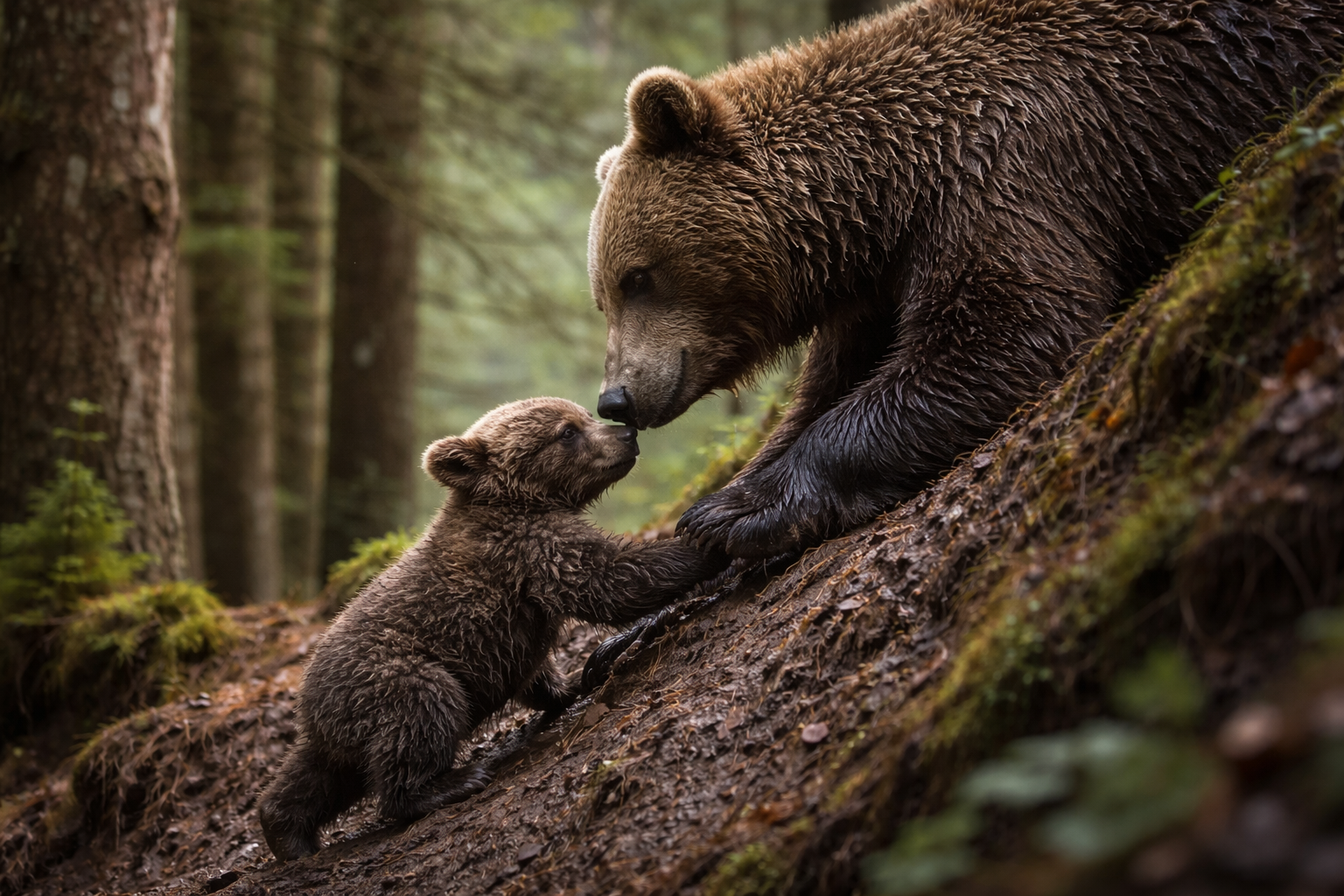

A remarkable moment captured on a remote trail camera has drawn widespread attention after showing a mother bear gently encouraging her cub to climb a steep, challenging slope. The footage, recorded as part of a wildlife monitoring project, offers a rare and intimate look into animal behaviour that is seldom witnessed in the wild.
Events like this are valuable not only for their emotional impact but also for the insight they provide into how animals learn, adapt, and survive in natural environments.
What the Footage Shows
The short sequence shows a young cub struggling to navigate a steep incline while its mother remains nearby, guiding and waiting. Rather than abandoning the cub or moving ahead, the mother repeatedly pauses, allowing the cub to attempt the climb and regain footing.
Researchers note that such behaviour reflects a balance between protection and independence, where the cub is encouraged to develop essential survival skills while still under the mother’s supervision.
Trail cameras, which are often placed in remote areas to monitor wildlife activity, have become an important tool in capturing these otherwise unseen interactions.
Why This Matters
Observations like this contribute to a deeper understanding of animal development and learning. Young animals rely heavily on early experiences to build the skills needed for survival, including navigation, hunting, and avoiding danger.
Parental behaviour plays a crucial role in this process. In species like bears, mothers invest significant time and energy into raising their young, teaching them how to respond to environmental challenges.
Beyond scientific value, such moments also help highlight the complexity of wildlife behaviour, challenging simplified assumptions about animal instincts and intelligence.
| Key Point | Detail | Significance |
|---|---|---|
| Species | Bear and cub | Maternal behaviour study |
| Behaviour | Guided climbing attempt | Learning through experience |
| Method | Trail camera recording | Non-intrusive observation |
| Context | Natural habitat | Real-world behaviour insight |
What Comes Next
Researchers will continue to analyse similar footage to identify patterns in behaviour and development across different environments and species. As monitoring technology improves, more detailed and frequent observations are expected.
These insights can also inform conservation efforts, particularly in understanding how animals adapt to changing habitats and environmental pressures.
Conclusion
The interaction between the mother bear and her cub offers a powerful reminder of the complexity of life in the wild. While the moment may appear simple, it reflects a critical stage in the cub’s development and highlights the role of guidance, patience, and adaptation in survival.
As more such moments are captured, they continue to deepen understanding of wildlife and the environments these animals depend on.
Disclaimer
This article is based on observed wildlife footage and research interpretations. Behaviour may vary across species, environments, and individual animals.